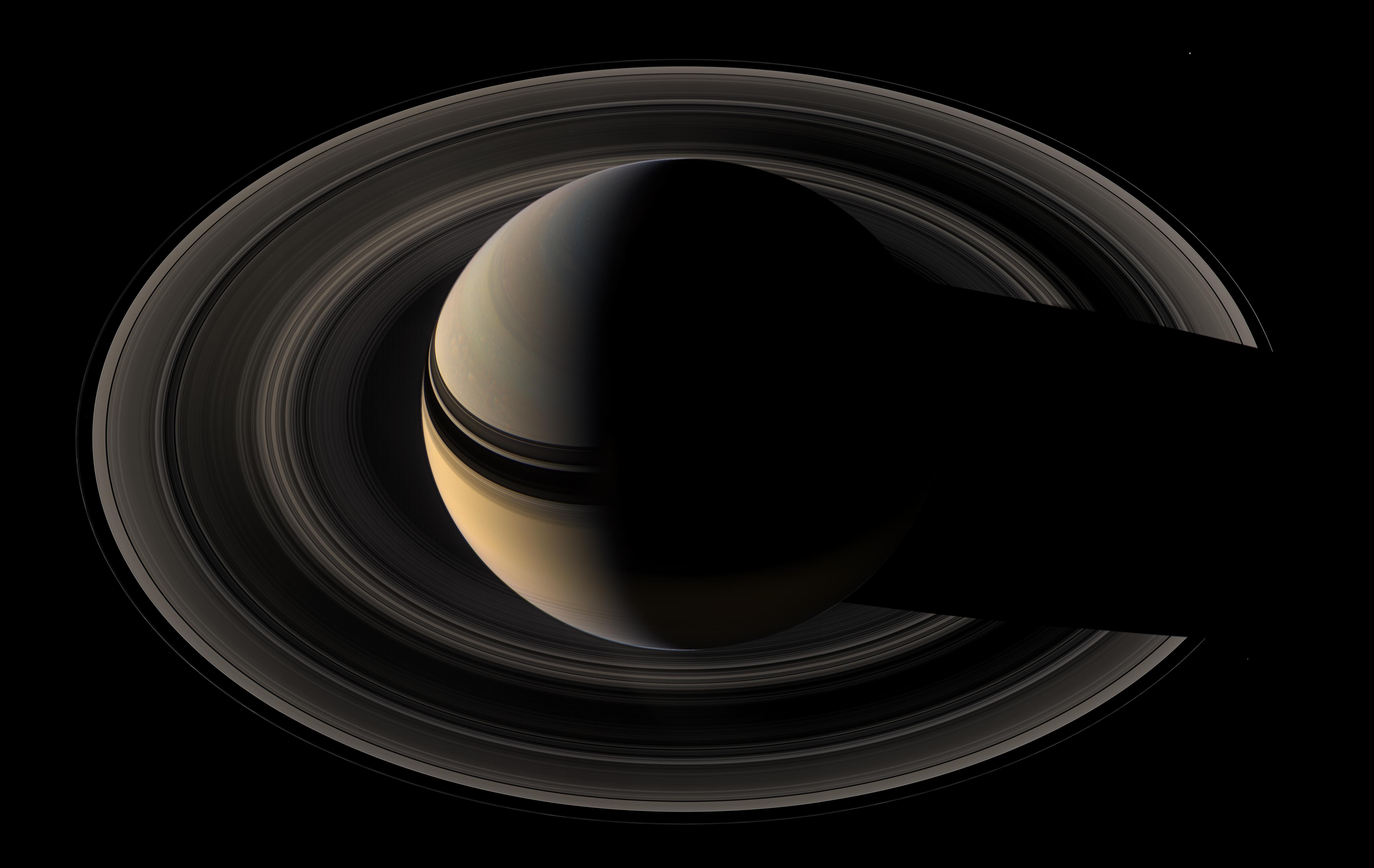
This is an image of Saturn as taken by the hardy little Cassini spacecraft, which orbits the ringed planet and takes photos like this. This doesn't look real to me but apparently it is, so apparently I have a lot to learn about the universe. It's awesome being able to see the shadow of the planet on its "rings" which are not rings but space dust and rocks pulled into Saturn's orbit. As it's impossible from Earth to see Saturn in a crescent phase, it's nice to see it from the Cassini ship.
Friday, October 26, 2007
APOD 2.1
This is an image of Saturn as taken by the hardy little Cassini spacecraft, which orbits the ringed planet and takes photos like this. This doesn't look real to me but apparently it is, so apparently I have a lot to learn about the universe. It's awesome being able to see the shadow of the planet on its "rings" which are not rings but space dust and rocks pulled into Saturn's orbit. As it's impossible from Earth to see Saturn in a crescent phase, it's nice to see it from the Cassini ship.
Sunday, October 14, 2007
Observation - October 11th, 2007
October 11th, 2007
7:30 - 9:00 PM
Clark Rd, east of the interstate
Clear skies, moon not present, some lights to the northwest which obstruct view
Instruments used: Naked eye, really high-powered laser pointer, big telescope (not sure of specifications)
Planets: Jupiter and its four moons, all four forming a nearly straight line to the southeast
Bright stars noted: Vega, Deneb, Altair (summer triangle), Polaris, Antares
Constellations noted: Lyra, Cygnus, Aquila (contain summer triangle stars), Ursa Minor (Little dipper), Scorpius, Scutum, Hercules (keystone asterism), Sagittarius (teapot asterism), Delphinus (Job's Coffin)
Binary stars: Epsilon Lyrae double-double
Deep Sky objects: M57 (Ring nebula) faint smoke-ring
Other: saw Milky Way
7:30 - 9:00 PM
Clark Rd, east of the interstate
Clear skies, moon not present, some lights to the northwest which obstruct view
Instruments used: Naked eye, really high-powered laser pointer, big telescope (not sure of specifications)
Planets: Jupiter and its four moons, all four forming a nearly straight line to the southeast
Bright stars noted: Vega, Deneb, Altair (summer triangle), Polaris, Antares
Constellations noted: Lyra, Cygnus, Aquila (contain summer triangle stars), Ursa Minor (Little dipper), Scorpius, Scutum, Hercules (keystone asterism), Sagittarius (teapot asterism), Delphinus (Job's Coffin)
Binary stars: Epsilon Lyrae double-double
Deep Sky objects: M57 (Ring nebula) faint smoke-ring
Other: saw Milky Way
Friday, October 12, 2007
Ole Roemer Biography
Thatcher Svekis
Mr. Percival
Astronomy 0
12 Oct. 2007
Ole Roemer
In Arhus, Jutland, on September 25th, 1644, Ole Christensen Roemer was born into the world he would so intensively study for the majority of his life. Dying on September 23rd, 1710, two days before his sixty-sixth birthday, Roemer would best be remembered as the astronomer who determined convincingly that light had a definite speed.
Roemer was not born into a high class, as his father was a skipper and his mother the daughter of an alderman. As he lived in relative obscurity, not much is known about him until his emergence in 1662 at the age of eighteen. This was when he was immatriculated into the University of Copenhagen and served as an apprentice and pupil to Rasmus Bartholin. Fortunately for Roemer’s future in astronomy, Bartholin had been assigned the task of preparing Tyco Brahe’s observations for publication, so Roemer was given a great in-depth look at the particulars of astronomy. In 1671 he would assist astronomer Jean Picard in locating Brahe’s observatory, and would serve as a companion to Picard in Paris for nine years after 1672. This time was spent making observations at France’s royal observatory, teaching the Dauphin, and constructing the beautiful fountains at Versailles. It was also in this time that he would observe the moons of Jupiter. Unlike Galileo though it was not to prove heliocentrism, but instead to shed light on…light.
Roemer began tracking Jupiter’s nearest moon Io as it orbited the planet, and he observed naturally that it orbited in the same amount of time every time. Six months later, Roemer observed that Io emerged from the shadow fifteen minutes later than usual. Roemer took into account the movement of Earth compared to Jupiter, thus accounting for the delay. To lose these fifteen minutes, Roemer calculated that Earth had to move 192,500 miles per second. Was he right? Well he was within three percent, which is pretty good for more than three hundred years ago. From this information Roemer predicted when the fifteen minutes would be gained back, and was correct about that too. At the age of thirty-one, Roemer presented these findings to the Academy to set the precedent that light has a finite speed, and is not affected by relative movement.
He would be best remembered for this discovery about light, but would still have an eventful remainder of his life. He embarked on a scientific mission to England in 1679, meeting gravity-establisher Isaac Newton, Edmund Halley, and John Flamsteed. Upon his return to Denmark in 1681 he was appointed the professor of astronomy at the University of Copenhagen. He married the daughter of his mentor Bartholin, and as royal mathematician introduced Denmark’s first national system of weights and measures in 1683. In 1700 he convinced the king of Denmark to introduce the Gregorian calendar, which Tyco Brahe failed to do so a century earlier, and established a few navigation schools throughout Denmark. He would serve as Chief of Police in Copenhagen until he died, and was most remembered for firing the entire staff upon his promotion due to low morale. He introduced oil street lamps in Copenhagen and exhibited a sort of social reform by trying to limit the number of homeless in the city. Roemer passed away in Copenhagen in 1710 at the age of sixty-five, but was not forgotten in the city of his death. Though astronomy would remember him for establishing that light had a finite speed, Copenhagen would remember him as a hard-working citizen and proponent of social reform.
Works Cited
Leinhard, John H. "No. 682: the Speed of Light." The Engines of Our Ingenuity. University of Houston. 12 Oct. 2007.
"Ole Roemer." LoveToKnow1911. 29 Aug. 2006. 12 Oct. 2007.
The Biographical Encyclopedia of Astronomers.
Mr. Percival
Astronomy 0
12 Oct. 2007
Ole Roemer
In Arhus, Jutland, on September 25th, 1644, Ole Christensen Roemer was born into the world he would so intensively study for the majority of his life. Dying on September 23rd, 1710, two days before his sixty-sixth birthday, Roemer would best be remembered as the astronomer who determined convincingly that light had a definite speed.
Roemer was not born into a high class, as his father was a skipper and his mother the daughter of an alderman. As he lived in relative obscurity, not much is known about him until his emergence in 1662 at the age of eighteen. This was when he was immatriculated into the University of Copenhagen and served as an apprentice and pupil to Rasmus Bartholin. Fortunately for Roemer’s future in astronomy, Bartholin had been assigned the task of preparing Tyco Brahe’s observations for publication, so Roemer was given a great in-depth look at the particulars of astronomy. In 1671 he would assist astronomer Jean Picard in locating Brahe’s observatory, and would serve as a companion to Picard in Paris for nine years after 1672. This time was spent making observations at France’s royal observatory, teaching the Dauphin, and constructing the beautiful fountains at Versailles. It was also in this time that he would observe the moons of Jupiter. Unlike Galileo though it was not to prove heliocentrism, but instead to shed light on…light.
Roemer began tracking Jupiter’s nearest moon Io as it orbited the planet, and he observed naturally that it orbited in the same amount of time every time. Six months later, Roemer observed that Io emerged from the shadow fifteen minutes later than usual. Roemer took into account the movement of Earth compared to Jupiter, thus accounting for the delay. To lose these fifteen minutes, Roemer calculated that Earth had to move 192,500 miles per second. Was he right? Well he was within three percent, which is pretty good for more than three hundred years ago. From this information Roemer predicted when the fifteen minutes would be gained back, and was correct about that too. At the age of thirty-one, Roemer presented these findings to the Academy to set the precedent that light has a finite speed, and is not affected by relative movement.
He would be best remembered for this discovery about light, but would still have an eventful remainder of his life. He embarked on a scientific mission to England in 1679, meeting gravity-establisher Isaac Newton, Edmund Halley, and John Flamsteed. Upon his return to Denmark in 1681 he was appointed the professor of astronomy at the University of Copenhagen. He married the daughter of his mentor Bartholin, and as royal mathematician introduced Denmark’s first national system of weights and measures in 1683. In 1700 he convinced the king of Denmark to introduce the Gregorian calendar, which Tyco Brahe failed to do so a century earlier, and established a few navigation schools throughout Denmark. He would serve as Chief of Police in Copenhagen until he died, and was most remembered for firing the entire staff upon his promotion due to low morale. He introduced oil street lamps in Copenhagen and exhibited a sort of social reform by trying to limit the number of homeless in the city. Roemer passed away in Copenhagen in 1710 at the age of sixty-five, but was not forgotten in the city of his death. Though astronomy would remember him for establishing that light had a finite speed, Copenhagen would remember him as a hard-working citizen and proponent of social reform.
Works Cited
Leinhard, John H. "No. 682: the Speed of Light." The Engines of Our Ingenuity. University of Houston. 12 Oct. 2007
"Ole Roemer." LoveToKnow1911. 29 Aug. 2006. 12 Oct. 2007
The Biographical Encyclopedia of Astronomers.
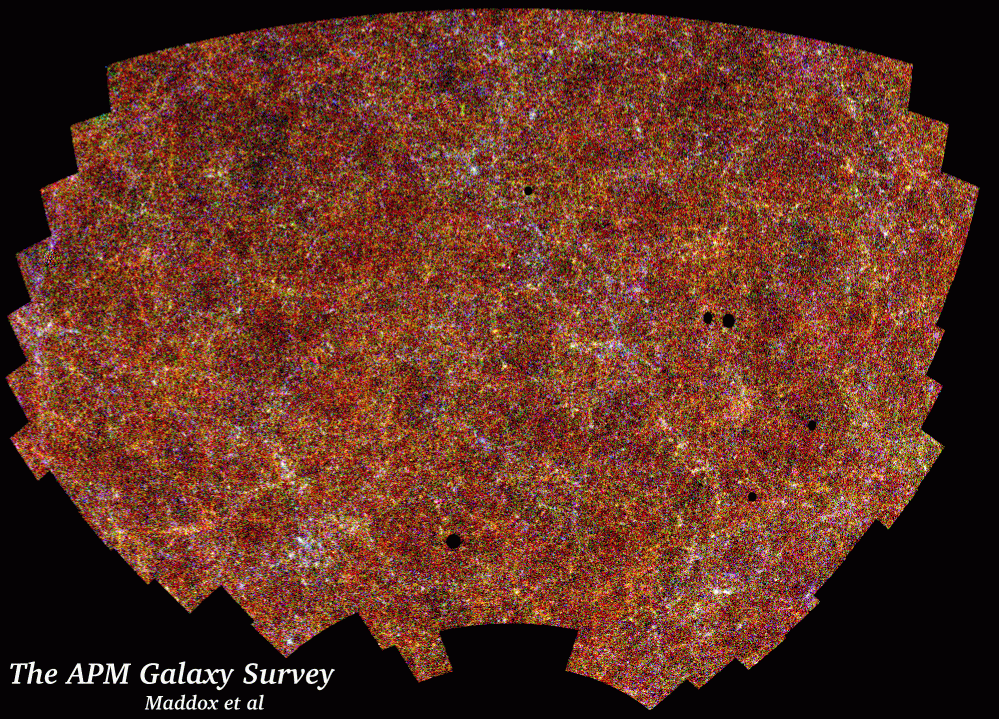
Saying that there are more stars in the universe than grains of sand on all the beaches sounds insane until you see this picture. Wow. 2 MILLION galaxies? Each containing their own amount of stars? Thats a heck of a lot. And that isn't even the entire universe, only a 100 degree slice of it. Too bad everything is millions of light years away and we can't even travel the speed of light, so we will definitely not get out there in my lifetime. The universe is a wondrous thing.
Friday, October 5, 2007
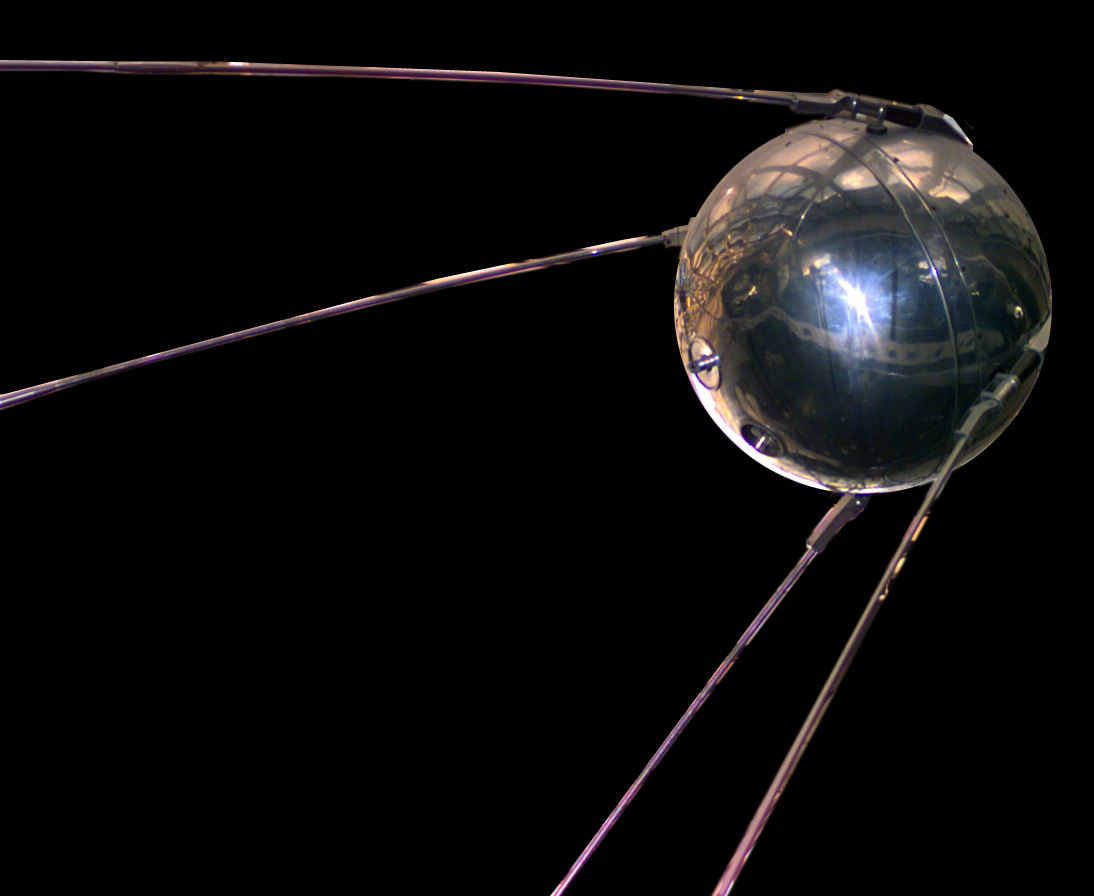
Looking at such a small and ugly thing it's hard to realize how important it was. Sputnik weighed 19 pounds more than me and is about four feet shorter, but probably had more an impact on the world than I ever will. I won't do anything close to being the first thing in space, starting the Space Race, inspiring the creation of NASA, or raising fears of spying Russians. At least I look better than this thing, which was surprisingly advanced for a time when we didn't have calculators. Oh technology.
Subscribe to:
Comments (Atom)